Sensing Sociability: The Neural Basis of Differences in Social Behavior (2022/46/A/NZ4/00256, MAESTRO, NCN)
Social behavior varies naturally between individuals, from social withdrawal to unusually high social attachment. This project investigates how these differences are represented in the brain, using mouse models to identify neural circuits that regulate sociability and to develop circuit-based strategies for rescuing social deficits.


Team

Hanna Trebesova

Ermis Ryakiotakis

Adam Brosnan

Konrad Danielewski

Marcin Lipiec

Maria Kalinowska
Successful social interaction is essential for communication, cooperation, learning, and adaptation to social environments. Yet individuals differ markedly in their tendency to seek and maintain social contact. While this variation is common in the general population, reduced sociability is also an early symptom of several brain disorders, including depression, schizophrenia, autism spectrum disorder, and Fragile X syndrome.
Despite its importance, little is known about how stable individual differences in sociability are encoded and maintained in the brain. This project addresses that gap by combining advanced behavioral tracking, neural circuit analysis, and mouse models of social impairment.
Testing causal links between neural circuits and social behavior is technically and ethically difficult in humans. Mice offer a powerful model system because they are social animals and display rich group behaviors when housed together. Using recently developed methods for recording and analyzing spontaneous social behavior, we can identify stable, trait-like differences in sociability and relate them to activity in specific neural circuits.
The project aims to:
- Define the physiological range of sociability at both behavioral and neural circuit levels.
- Characterize the dynamics of neural circuits involved in initiating and maintaining social interaction.
- Understand how circuits for social motivation interact with circuits for social information processing.
- Develop circuit-based rescue strategies for social deficits using knowledge of circuit function and physiology.
By identifying the neural circuits that causally regulate sociability, the project will help clarify how normal variation in social behavior becomes pathological. This knowledge may guide the development of targeted therapies for social impairments, including symptoms observed in neurodevelopmental and psychiatric disorders.
The project uses mouse models, unconstrained social behavior tracking, neural circuit mapping, and functional manipulation of identified circuits. These approaches allow the team to study naturalistic social behavior in animals embedded in a social structure, rather than focusing only on simplified laboratory tasks.
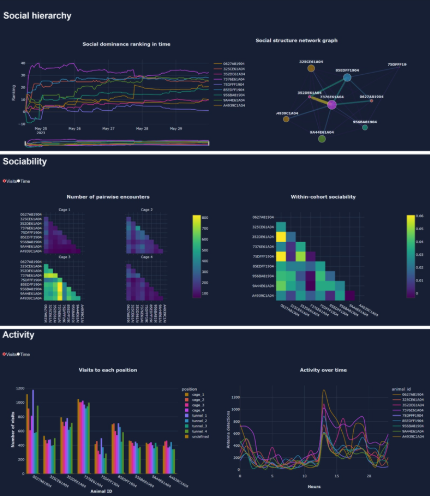
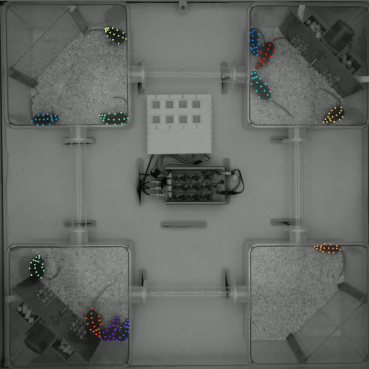
Eco-HAB system: automatic tracking of social relations
Recording and manipulating neuronal circuits controlling social behavior
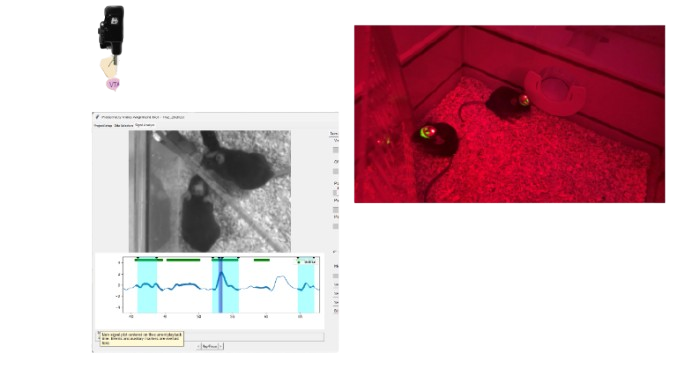
We study how specific neuronal circuits shape social behavior by combining precise recordings of brain activity with targeted circuit manipulations. This approach allows us to identify how defined pathways contribute to social interaction, motivation, and behavioral flexibility, and to understand how their dysfunction may lead to social deficits.